


Urban People Everyday Life CAD Blocks Collection
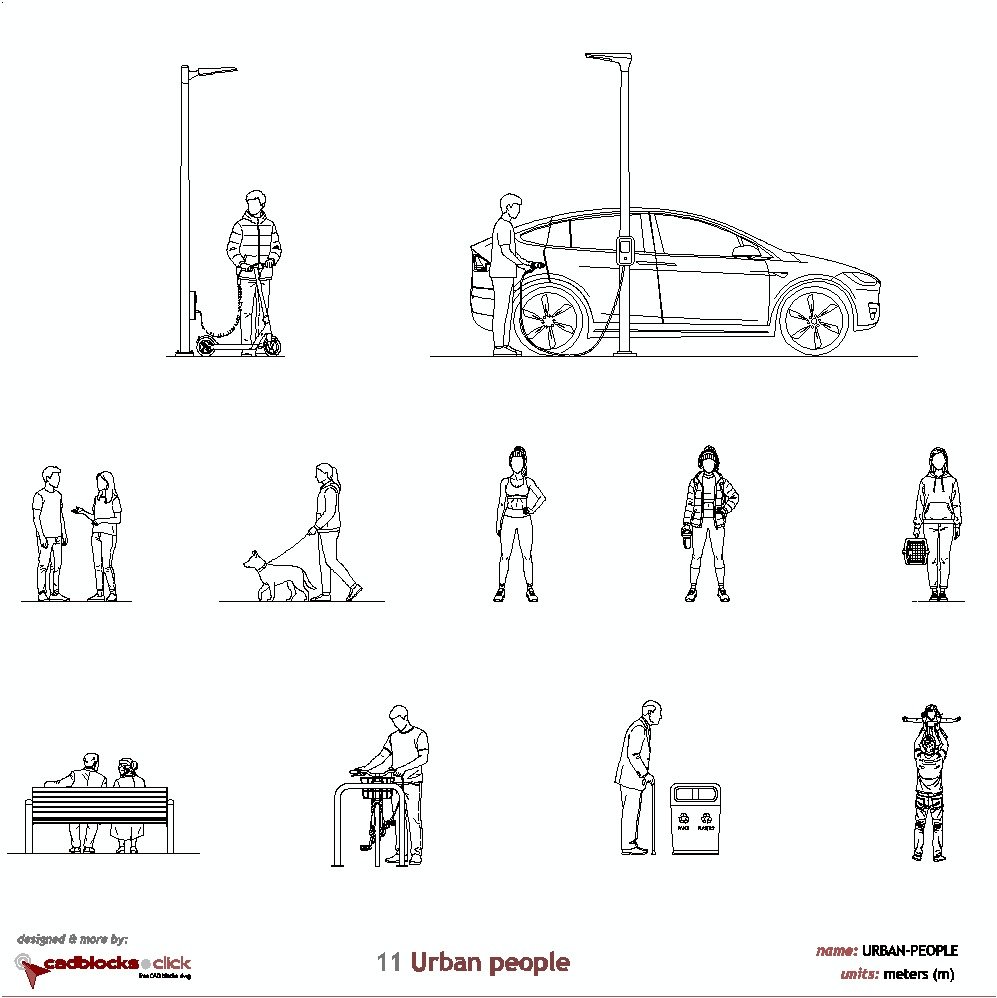
This collection of CAD blocks in .dwg format features 11 human figures representing everyday urban life, from sustainable mobility and social interaction to family life and active ageing in public space. The set portrays a diverse range of citizens and situations found in contemporary cities: users charging electric scooters and vehicles at street infrastructure, pedestrians walking dogs, young women in daily routines, elderly couples resting on benches, a person parking a bicycle, an older man near recycling bins, and a parent playing with a child. These blocks are ideal for urban design, public space planning, landscape architecture, and any architectural drawing that requires realistic, life-scale human figure references in elevation view.
size: 426 kb
category: people
related categories and subcategories:
description: A collection of CAD blocks in .dwg format featuring 11 human figures in everyday urban situations. These blocks are ideal for architects, urban designers, and landscape planners working on street layouts, public parks, pedestrian areas, sustainable mobility schemes, and neighbourhood regeneration projects. The set covers a wide range of ages, genders, and daily activities to bring life and human scale to technical drawings and architectural presentations.
The collection spans sustainable mobility scenarios such as electric vehicle and scooter charging at streetlight points, active mobility with bicycle parking, social and leisure scenes including a couple talking and elderly people resting, daily routine figures such as a woman walking a dog and a young woman commuting to the gym, and family life represented by a parent playing with a child. All figures are drawn in clean 2D elevation view for direct use in plans, sections, and architectural renders.
file extension: .dwg CAD - AutoCAD software

Detailed Specifications and Design Options for Urban People Everyday Life CAD Blocks
Diverse Human Figure CAD Blocks for Urban and Landscape Design
Our urban people CAD collection features 11 human figures that represent the full diversity of city life, from children playing and elderly people resting to young adults commuting, cycling, and interacting with sustainable urban infrastructure. These blocks are essential for urban design projects, public space master plans, landscape architecture, neighbourhood regeneration schemes, and transport corridor studies. Placing realistic human figures in technical drawings communicates scale, activity, and social vibrancy in ways that abstract symbols cannot, making presentations more persuasive and plans more legible to clients and planning authorities.
Included Figures and Scene Descriptions
The collection features 11 detailed human figure CAD blocks, each representing a specific everyday urban situation. All drawings are provided as precise 2D elevation views, ready for insertion into street sections, public space layouts, and architectural presentations.
Sustainable Mobility
Electric Scooter Charging at Streetlight: A young person charges an electric scooter using a power outlet integrated into a streetlight pole, representing the integration of micro-mobility charging within existing street furniture.
Electric Vehicle Charging at Streetlight: A man connects an electric car to a charging point installed on a streetlight, illustrating the growing presence of urban EV infrastructure within the public realm.
Bicycle Parking (Urban Rack Use): A young person parks and secures a bicycle to a metal safety rail or urban bike rack, representing active travel and the demand for cycle parking in pedestrian areas.
Pedestrian Activity and Daily Routines
Young Couple Talking (Front Elevation): A front view of a young couple standing and talking, illustrating casual social interaction in a public street or plaza.
Woman Walking Dog (Side Elevation): A side view of a woman walking a dog on a leash, representing everyday urban pedestrian activity and the presence of pets in public space.
Young Woman – Gym Outfit (Front Elevation): A front view of a young woman wearing gym clothing, standing in a neutral pose. Useful for active lifestyle contexts such as sports parks, fitness zones, and pedestrian promenades.
Young Woman – Streetwear to Gym: The same woman dressed for commuting to the gym, wearing a padded jacket, backpack, over-ear headphones, and holding a protein shake, illustrating the active urban commuter.
Young Woman Carrying Pet Carrier: A front view of a young woman wearing a hoodie and holding a cat carrier, indicating pet transportation in an urban setting such as a vet corridor or residential street.
Elderly Users and Inclusive Design
Elderly Couple Seated on Public Bench (Rear View): Two elderly people, seen from behind, sitting on a park bench, representing rest, leisure, and social engagement in public space. Particularly useful for illustrating the human scale of seating areas and park furniture.
Elderly Man with Cane Near Recycling Bins: An older man with a walking cane stands near recycling containers for paper and plastic waste, representing the importance of accessible waste management infrastructure for older users in public space.
Family and Intergenerational Interaction
Parent Playing with Child (Rear View): A father lifts his daughter overhead, representing play, affection, and family interaction in a public park or playground area. Shown from behind, this figure adds warmth and human scale to leisure space drawings without distracting from technical content.
Application in Public Space, Street Design, and Landscape Projects
These urban people CAD blocks are designed for integration in street section drawings, public space master plans, park and plaza layouts, pedestrian corridor studies, and sustainable mobility schemes. Their use brings human scale and social context to technical drawings, helping convey how a space will be experienced by its future users. The inclusion of diverse ages and activities supports inclusive design narratives, accessibility assessments, and community engagement presentations. Front, side, and rear elevation views allow designers to populate drawings from multiple viewpoints without visual inconsistency.
Urban Design Standards for Inclusive and Sustainable Public Space
When designing public spaces and streets that accommodate the full diversity of urban life, the following standards and recommendations should be observed:
- Pedestrian clearance widths: Footways and shared surfaces should provide a minimum unobstructed width of 1,800 mm for comfortable two-way pedestrian flow, increasing to 3,000 mm or more in high-footfall areas such as city centre streets and transit nodes.
- Cycle parking provision: Urban bike racks should be sited within 30 metres of the destination entrance, at a density of at least one stand per 10 expected visitors in retail and leisure contexts. Sheffield-style stands remain the preferred standard for their security and accessibility.
- EV and micro-mobility charging: Streetlight-integrated charging points should comply with relevant electrical standards (IEC 61851 / BS 7671) and be positioned to avoid obstruction of the pedestrian route, with a minimum 900 mm clearance on all sides.
- Seating and rest provision: Guidance from age-friendly city frameworks recommends a seat within 100 metres of any point along a primary pedestrian route, with armrests and a seat height between 430 mm and 480 mm to support ease of use by older adults.
- Pet-friendly design: Public spaces accommodating dog walkers should include waste bin provision at intervals of no more than 100 metres, along with clearly defined dog-free zones around play equipment and outdoor dining areas.
- Waste and recycling infrastructure: Recycling points in public space should be universally accessible, with a maximum reach height of 1,200 mm for bin apertures and clear contrast markings to support users with visual impairments.
- Play and family areas: Spaces designed for family use should include a mix of active and passive play equipment, seating for carers within direct sightline of play areas, and safe surfacing zones with a minimum impact-attenuation depth appropriate to the installed equipment.
For further reference, consult WHO Age-Friendly Cities guidelines, national pedestrian and cycle infrastructure design standards such as Manual for Streets (UK), and local sustainable mobility plans.
12 People Using Self-Service Machines
22 Personal Mobility Devices
52 Silhouettes of Playing Children
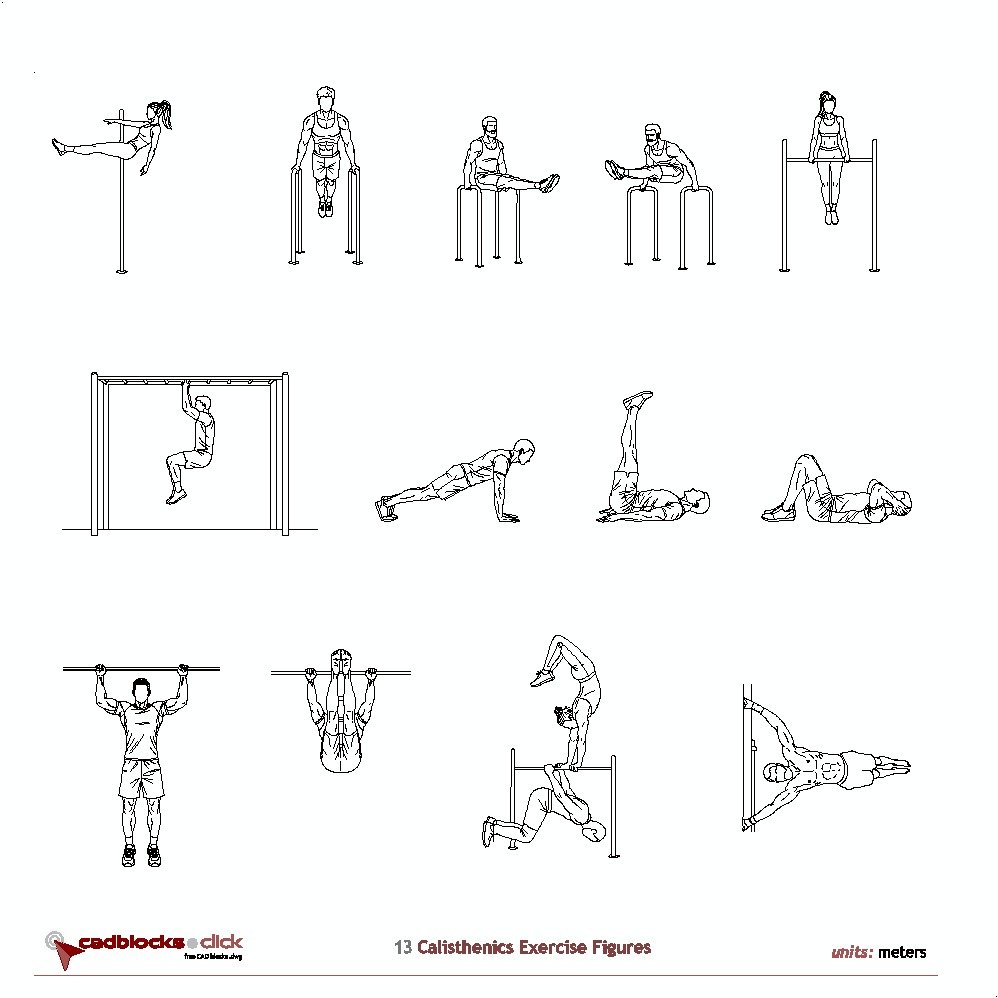
13 Calisthenics Exercises and Bodyweight Training
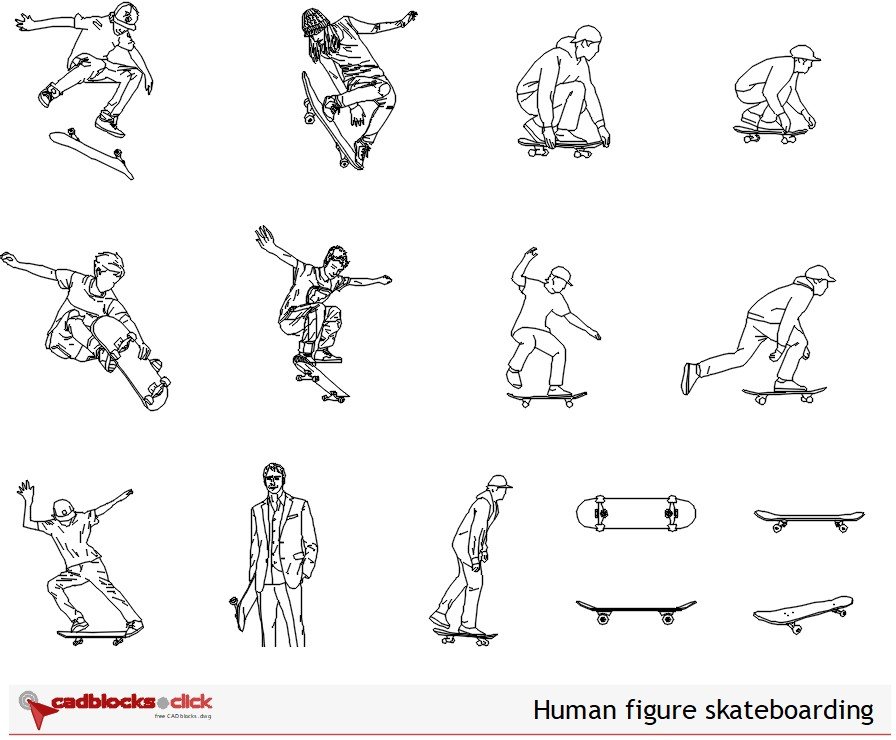
15 Young Skaters and Skateboard
 click and go to morepersons CAD blocks:




click and go to otherpeople - humans DWG drawings:




click and download3D people AutoCAD models:


access and download more outdoor sports surfaces for AutoCAD:





click and downloadurban furnishings CAD models:







click and download 2D other CAD blocks:



Tree Elevations - Color and Gray Shading

Thick and Fine Line Elevations Trees

22 Elevation Trees


© 2025 CADblocks.click. All rights reserved